
Why Camera Specs Raise Phone Prices: 2026 Guide
Advanced camera hardware is the single largest driver of phone price increases in 2026. Adding larger sensors, variable aperture lenses, or periscope zoom modules raises the Bill of Materials (BoM) sharply. As a result, that cost passes directly to you at retail. Supply chain analyst Ming-Chi Kuo reported that the iPhone 18 Pro’s camera upgrade alone costs Apple 50% more than the previous model. That adds an estimated $200–$300 to the retail price. So understanding why camera specs raise phone prices helps you make a smarter buying decision.
Why camera specs raise phone prices: the hardware cost breakdown
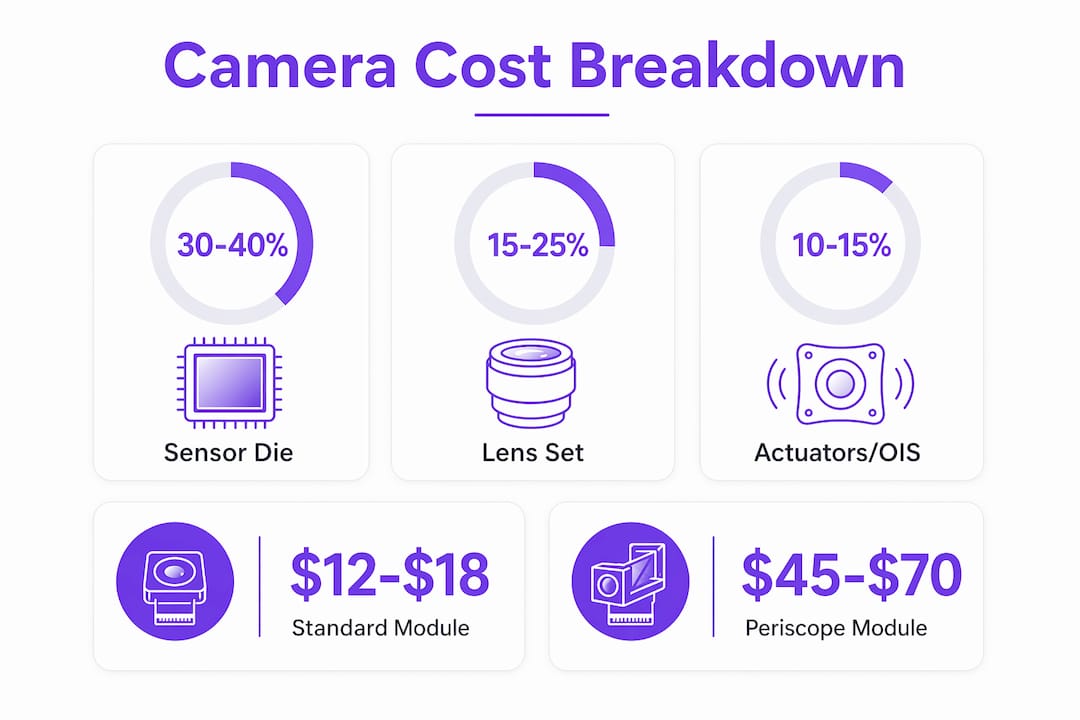
Camera price increases come from hardware, not just higher pixel counts. Each camera module has several parts. Premium versions of each part add cost fast.
To start, the sensor die is the most expensive single part. Sensor die costs account for roughly 30–40% of total camera module cost. A larger sensor die captures more light. However, it also needs a bigger chip, tighter manufacturing, and a larger lens.

The lens set adds another 15–25% of module cost. Actuators and optical image stabilization (OIS) systems contribute 10–15%. Assembly and packaging complete the total. Consequently, every upgrade tier costs more.
Here is how the cost gap looks across module types:
|
Module type |
Approximate cost |
Key cost driver |
|
Standard 12MP module |
$12–$18 |
Basic sensor die, fixed lens |
|
Periscope/telephoto module |
$45–$70 |
Complex prism optics, larger sensor die |
|
Variable aperture lens module |
~50% more than prior gen |
Mechanical iris, precision calibration |
Periscope modules cost $45–$70 to build, compared to just $12–$18 for a standard module. These designs bend light at a 90-degree angle using a prism. This allows long zoom without a thick camera bump. The optics need tighter tolerances and more costly glass.
Variable aperture lenses go even further. These lenses add significant mechanical complexity. Calibration and close integration are both required. A moving iris must survive thousands of cycles without losing quality. That drives up both parts costs and quality control.
Pro Tip: When comparing phones, check whether a telephoto lens uses a periscope design or a standard protrusion. Periscope designs cost more to build and typically deliver better optical zoom quality, so they signal a genuine hardware investment rather than a marketing upgrade.
Do megapixels actually determine camera quality and price?
Megapixels are the most marketed camera number. But they explain the least about real image quality or price. Megapixel count correlates with sharpness at only about 0.28 in bright light. That is a weak link. In contrast, aperture and sensor size matter more in real-world results.
The reasons for this gap are worth understanding:
- Take a 200MP sensor crammed onto a small die — it uses tiny individual pixels. Smaller pixels collect less light, which hurts low-light performance.
- By contrast, a 50MP sensor on a larger die often outperforms the 200MP sensor in dim conditions, even though its megapixel number is lower.
- Aperture determines how much light enters the lens. A wider aperture (lower f-number) lets in more light and produces better results in dark environments, regardless of megapixel count.
Software processing compounds this further. Image sharpness depends more on software than any single hardware spec. Good processing can effectively double perceived sharpness. Manufacturers invest heavily in night mode, AI scene detection, and multi-frame stacking to get the most from their hardware.
“Consumers overvalue megapixels due to marketing, whereas aperture, sensor size, and software processing explain more about actual image quality and justify pricing differences.” — Bandicoot Lab, May 2026
Ultimately, this matters for your buying decision. A phone with a high megapixel count may take worse photos than a cheaper phone with better software. The spec sheet does not tell the whole story.
How supply chain factors push camera costs even higher
External pressures also push camera costs higher. Global DRAM and NAND flash shortages are pushing memory prices up. That squeezes phone production budgets. Memory and camera parts compete for the same money.
The supply chain effects on camera pricing follow a clear sequence:
1. First, memory prices rise. DRAM and NAND shortages push up storage and RAM costs — both non-negotiable in any modern phone.
2. Next, manufacturers face a budget squeeze. Total BoM costs increase before any camera upgrade is added. Margins compress.
3. As a result, camera hardware trade-offs begin. Phone brands may sacrifice large camera sensors to survive a memory crisis, choosing cheaper sensors and using software to close the quality gap.
4. In response, software investment increases. Computational photography becomes the main tool when hardware specs are cut.
5. Finally, premium models absorb full costs. Flagship phones with premium sensors pass all cost increases to the buyer.
Furthermore, supplier lock-in adds another layer of cost pressure. Periscope and variable aperture lenses need specialist suppliers. Very few exist globally. When demand outstrips supply, prices rise. Brands with existing supplier deals gain an edge — but that edge has a cost baked into every phone sold.
Pro Tip: If a new flagship phone launches with a major camera upgrade and a significant price jump, check whether the upgrade is hardware-based (new sensor, new lens mechanism) or software-based (new processing algorithms). Hardware upgrades justify higher prices more reliably than software updates, which can sometimes be delivered to older models.
How camera costs translate to the price you pay at retail
The iPhone 18 Pro shows how hardware costs hit retail prices directly. It could start at $1,399, driven by the variable aperture upgrade and rising memory costs. That is a $200–$300 jump from the previous generation. In fact, the camera module alone accounts for a substantial portion of that increase.
Flagship phones carry higher markups. Camera investment is concentrated at the top of the market. Manufacturers recover R&D, tooling, and component costs through flagship prices. Mid-range phones get trickled-down technology. However, they rarely get the newest camera hardware in year one.
For buyers evaluating camera specs and phone cost, the practical questions are:
- First, does the phone use a periscope zoom lens or a standard telephoto? Periscope designs cost more and deliver better optical zoom.
- What is the aperture of the main camera? A wider aperture matters more in low light than extra megapixels.
- Also, does the manufacturer have a strong software processing reputation? Good algorithms can close the gap between a $400 phone and an $800 phone in many shooting conditions.
- Are you paying for a new mechanical feature like variable aperture, or for a spec number increase that may not change your photos?
The best camera phones at any price point are the ones where hardware and software work together. A phone with a large sensor, wide aperture, and strong processing will beat a higher-megapixel phone with weaker optics in almost every real situation.
Key takeaways
Camera hardware complexity is the main reason advanced specs raise phone prices. Moreover, software processing determines the image quality you actually get.
|
Point |
Details |
|
Hardware drives cost |
Sensor die, lens set, and OIS together determine module cost, not megapixels alone. |
|
Periscope zoom is expensive |
Telephoto periscope modules cost $45–$70 versus $12–$18 for standard modules. |
|
Megapixels mislead buyers |
Sharpness correlation with megapixels is only 0.28; aperture and sensor size matter more. |
|
Supply chain adds pressure |
DRAM and NAND shortages push total BoM costs higher, amplifying camera upgrade price hikes. |
|
Software closes hardware gaps |
Strong processing pipelines can match or beat higher-spec hardware at lower price points. |
The megapixel trap is real, and most buyers fall into it
After years of tracking phone prices in Pakistan, one pattern is clear: the megapixel number on a spec sheet sells phones. But it rarely explains the difference between a good camera and a great one.
In 2026, the phones that justify their price invest in real optical hardware. Variable aperture lenses, periscope zoom, and large sensors cost money to build. When you see a $200 price jump and the difference is a new lens, that premium is usually earned.
On the other hand, what frustrates me is phones marketed on 200MP numbers. They often use tiny pixels that underperform a 50MP phone in low light. That is a marketing call, not an engineering one. Buyers who understand aperture and sensor size will not be fooled. Those who only read the megapixel number, however, often will be.
So my advice is simple: check the aperture and sensor size first, not megapixels. Then see if the telephoto is a periscope design. Finally, look at sample photos in low light. Those three steps beat any spec sheet.
— MobileDaam Editorial Team
Compare camera specs and prices on Mobiledaam
Choosing a phone with the right camera for your budget is much easier when you can see specs and prices side by side.

Mobiledaam lists over 500 phones with daily price updates. Additionally, it covers everything from budget models to flagships with periscope zoom and variable aperture. The phone comparison tool lets you place two phones side by side and evaluate camera hardware differences against real Pakistani retail prices. If you already know which brands interest you, the phone finder tool filters by camera features, budget, and specs to narrow your options fast. Mobiledaam also has a PTA tax calculator, so the price you see is what you actually pay.
FAQ
Why do camera specs raise phone prices so much?
Advanced camera hardware like periscope zoom modules and variable aperture lenses costs significantly more to manufacture than standard modules. As a result, those component costs pass directly to the retail price.
Does a higher megapixel count mean better photos?
Megapixel count correlates with sharpness at only about 0.28, making it a weak predictor of image quality. Aperture, sensor size, and software processing have a stronger impact on real-world results.
What is the most expensive part of a phone camera?
The sensor die accounts for roughly 30–40% of total camera module cost, making it the single most expensive component in a smartphone camera system.
How much more does a periscope zoom lens cost to build?
Periscope telephoto modules cost approximately $45–$70 to manufacture, compared to $12–$18 for a standard 12MP module, due to complex prism-based optics and larger sensor dies.
Can software replace expensive camera hardware?
Software processing can close a significant quality gap, and research shows it can effectively double perceived sharpness. However, optical hardware like sensor size and aperture sets a ceiling that software alone cannot exceed.